 UAE
UAE
 Qatar
Qatar
 Pakistan
 KSA
KSA
 Oman
Oman
 Kuwait
 Bahrain
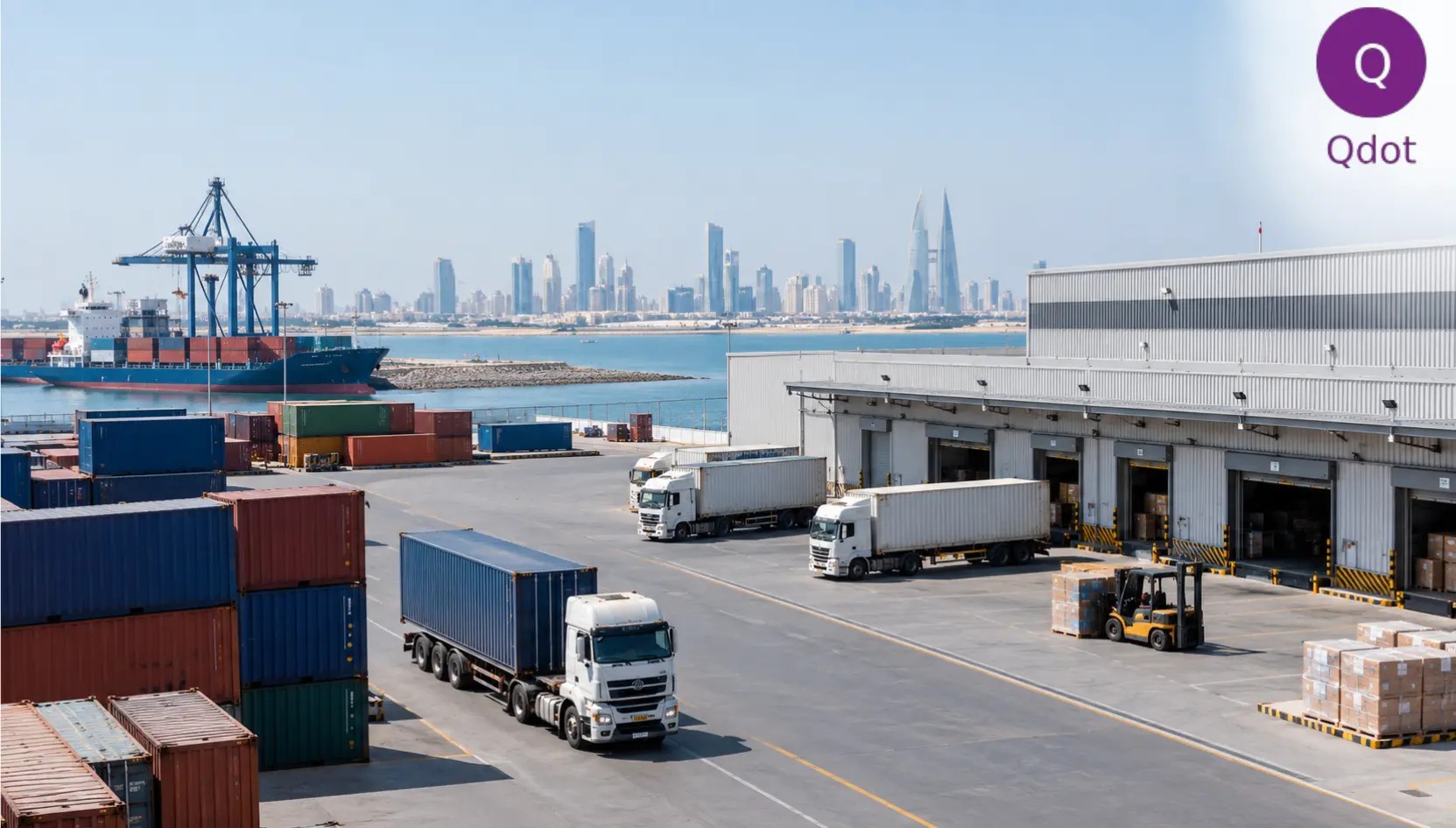
Bahrain is small, and that shapes how cargo moves through it. A container can clear Khalifa Bin Salman Port, sit in a Bahrain Logistics Zone warehouse and leave by truck across the King Fahd Causeway in the same day. That closeness is a real advantage, but it also means a delay, a security gap or a safety incident at one point affects the whole chain faster than it would in a larger country. As government tenders, GCC clients and international shippers ask logistics companies to prove their processes actually work, ISO certification has become a practical way to do that.
Bahrain's Ports, Airport and Logistics Zone at a Glance
Bahrain's logistics activity runs through a handful of connected locations rather than being spread out:
- Khalifa Bin Salman Port (KBSP), the country's main container port in the north, close to Muharraq
- Mina Salman Port, the older commercial port, still used for general cargo and various berthing needs
- Bahrain Logistics Zone (BLZ), a customs bonded park next to KBSP built for freight forwarding, storage and distribution
- Bahrain International Airport, which handled a record 405,217 tonnes of air cargo in 2025, supported by Gulf Air alongside dedicated freight carriers such as DHL and Cargolux
- King Fahd Causeway, the road link to Saudi Arabia and the main route for truck freight moving into the wider GCC market
This setup sits at the centre of Bahrain's National Logistics Services Sector Strategy (2022 to 2026), which treats logistics as one of the sectors expected to grow the economy beyond oil and gas.
What Freight, Warehousing and Transport Companies Do in Bahrain
Most companies in this sector combine more than one activity rather than specialising in just one:
- Freight forwarding, shipping agency work and customs clearance at the ports and airport
- Bonded and general warehousing, including pick, pack and distribution for retail and e-commerce clients
- Road haulage between Bahrain, Saudi Arabia and the wider GCC, mainly via the Causeway
- Air cargo handling, express courier services and last mile delivery
- Cold chain and temperature controlled storage for food, pharmaceuticals and medical supplies
- Third party logistics (3PL), where one company runs storage, transport and order fulfilment together
Because these activities often sit under one roof, for example a warehouse operator that also runs its own delivery fleet, a management system needs to cover how cargo moves through the whole operation, not just one part of it.
Risks That Come With Running a Small Island Supply Chain
A few risks show up repeatedly for logistics businesses in Bahrain:
- Limited redundancy. With two ports, one airport and one causeway carrying most of the trade, a delay at any single point has an outsized effect on an economy that depends heavily on imports.
- Heat and humidity. High temperatures for much of the year put pressure on vehicle maintenance, warehouse conditions and anything moving through cold chain storage.
- Yard and warehouse safety. Forklift movement, container stacking and heavy vehicle traffic in loading bays remain a leading cause of workplace incidents.
- Security and customs expectations. Bahrain Customs Affairs runs its own Authorised Economic Operator programme under the GCC AEO framework, which rewards companies that can show documented, auditable control over cargo and premises.
- Service level pressure. Growth in e-commerce and express delivery means customers now expect tracking accuracy and on-time delivery as standard.
- Environmental exposure. Fuel handling, vehicle emissions and waste from port, yard and workshop operations sit close to a coastline Bahrain's environmental rules increasingly focus on protecting.
Most of these risks are not new. What has changed is that ports, government departments and corporate shippers increasingly expect a documented system behind how a company controls them, not just a policy on paper.
ISO Standards for Bahrain's Logistics and Supply Chain Companies
Not every standard applies to every company in this sector. These are the ones that genuinely fit freight, warehousing and transport operations in Bahrain:
| Standard | What It Covers | Why It Matters Here |
|---|---|---|
| ISO 9001 | Quality management | Needed for tender prequalification with ports, government bodies and corporate shippers; standardises how errors and complaints are handled |
| ISO 45001 | Workplace health and safety | Covers forklift, yard and warehouse safety risks common across ports, depots and distribution centres |
| ISO 14001 | Environmental management | Manages fuel, waste and emissions from vehicle yards, workshops and warehouse sites |
| ISO 28000 | Supply chain security | Covers cargo security and access control; overlaps with Bahrain's GCC AEO requirements |
| ISO 22301 | Business continuity | Plans for causeway congestion, port disruption or extreme weather, given Bahrain's limited alternative routes |
| ISO 27001 | Information security | Protects shipment tracking data, customer details and access to customs and EDI systems |
| ISO 22000 | Food safety | Relevant for companies running cold chain storage for food or pharmaceutical cargo |
Companies rarely need every standard on this list. A freight forwarder's priorities usually centre on ISO 9001 and ISO 27001, while a warehouse or trucking operation leans more on ISO 45001 and ISO 14001. Qdot's ISO consultancy in Bahrain can help confirm which combination actually fits your operation before you commit to a scope.
AEO and ISO 28000 are not the same thing. Bahrain's GCC AEO programme, run by Customs Affairs, is a customs trade facilitation scheme. ISO 28000 is an international supply chain security standard. Companies working toward AEO status often find the two share a lot of the same documentation, which can make pursuing both more efficient.
How Qdot Helps Bahrain's Logistics Companies Build a Working ISO System
Because this sector often spans a port office, a warehouse and a vehicle yard, Qdot starts by mapping how cargo actually moves between them: who signs off at each handover, where records already exist, and where gaps would show up in a real audit. From there, we build procedures, checklists and risk assessments your team can maintain day to day, not a folder of documents that only gets opened once a year.
Where a company needs more than one standard, for example ISO 9001 and ISO 45001 for a combined warehouse and fleet operation, we build them as a single integrated system rather than separate manuals. Qdot supports logistics and transport businesses across the Bahrain Logistics Zone, Hidd, Sitra and Muharraq, and through our wider ISO consultancy in Bahrain.
FAQs
Most companies start with ISO 9001, since it is the standard most often requested in tenders and client prequalification. Businesses with heavier safety exposure, such as warehouses and trucking fleets, often add ISO 45001 soon after.
No. AEO is a customs trade facilitation scheme run by Bahrain Customs Affairs under the GCC AEO framework. ISO 28000 is an international supply chain security standard. They are not identical, but the documentation for one often supports the other.
It depends on the actual risk. Driver fatigue, loading and heavy vehicle movement create injury risk regardless of cargo type, so a short risk review is usually enough to decide if it should be a priority.
Yes, provided the certification scope clearly lists every location and activity involved. This is common for Bahraini logistics groups running more than one site.
No. Qdot is a consultancy. We prepare your management system and your team for audit. The certificate is issued by an independent, accredited certification body.