 UAE
UAE
 Qatar
Qatar
 Pakistan
 KSA
KSA
 Oman
Oman
 Kuwait
 Bahrain
A construction project can finish on time yet still face rework, waste complaints or safety incidents. A factory may meet production targets while struggling with chemical handling or machine safety.
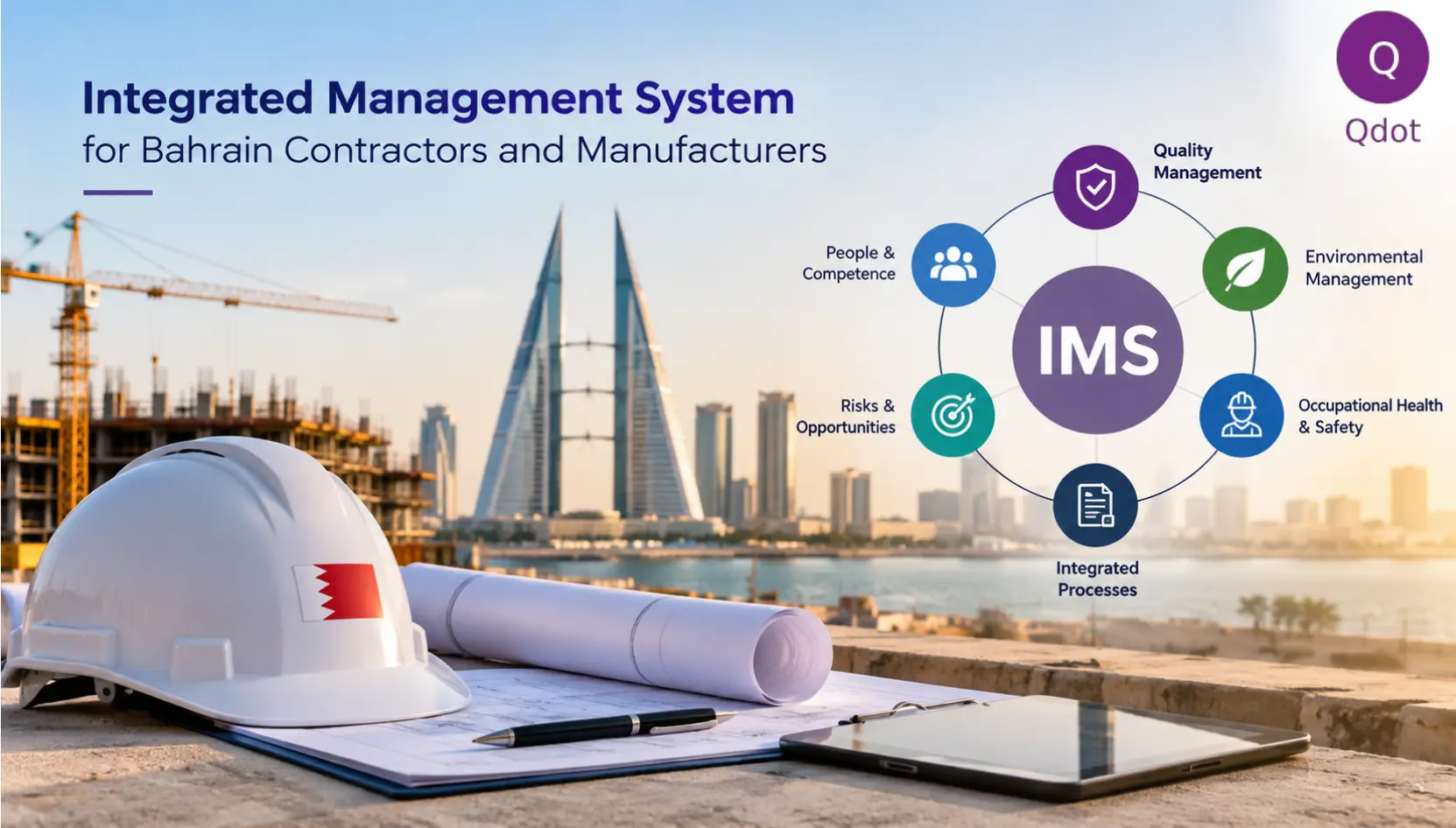
An integrated management system (IMS) gives Bahrain contractors and manufacturers a way to manage related responsibilities together. It connects shared quality, environmental and safety processes without removing specialist controls.
For Bahrain businesses considering an IMS, the key question is whether integration will make work easier to control, measure and improve.
What does an integrated management system actually do?
An IMS brings two or more management systems into a coordinated way of working. For contractors and manufacturers, a common combination covers three areas:
- Quality: meeting specifications, controlling changes and reducing defects through ISO 9001.
- Environment: managing waste, emissions, resource use and relevant environmental obligations through ISO 14001.
- Occupational health and safety: preventing injury and ill health, controlling hazards and involving workers through ISO 45001.
Their similar structures allow some activities to share owners, schedules and records. But the standards are not interchangeable. A quality inspection cannot replace a safety risk assessment, and a waste register cannot replace product traceability.
The aim is one connected way of managing the business, not one oversized procedure for everything.
Start with the business, not a ready-made template
A multi-site contractor has different needs from a Sitra fabrication workshop or a Hidd factory. Before designing an IMS, define the activities, sites, teams, outsourced work and customer requirements that it will cover.
A useful starting discussion includes:
- Which problems cross quality, environment and safety boundaries?
- Where do teams already use the same information or approvals?
- Which high-risk tasks need their own technical controls?
- Who has the authority to make decisions and provide resources?
- Are tenders, buyers or other interested parties asking for particular management-system evidence?
A realistic scope must reflect what supervisors and operators actually do.
Which IMS processes can be combined?
The table below shows practical choices, not a mandatory design.
| Process | What may be shared | What should remain specific |
|---|---|---|
| Business context and planning | One review of activities, stakeholders and major changes | Different quality, environmental and safety concerns |
| Risks and opportunities | A common reporting format and action tracker | Suitable methods for hazards, environmental aspects and quality risks |
| Objectives | One reporting dashboard and review calendar | Separate measures and targets for each discipline |
| Competence and records | One training matrix and document-control method | Task-specific skills, authorisations and technical records |
| Audits and management review | A coordinated programme and leadership meeting | Evidence and conclusions against every applicable requirement |
Never drop technical requirements to make the system look simpler.
Eight processes that make integration practical
1. Understanding context and interested parties
Management should consider issues that affect the business: project deadlines, supplier performance, workforce capabilities, client requirements, resource availability and relevant legal obligations. Interested parties may include customers, employees, subcontractors, authorities and nearby communities.
Keep one overview, with separate details for each discipline. For example, a factory expansion could affect production capacity, waste handling and employee exposure to new equipment. The same change has three different consequences, so all three need attention.
2. Managing risks and opportunities
A combined action register can simplify follow-up without hiding important differences. Quality teams might assess the risk of incorrect drawings or defective materials. Environmental personnel may evaluate significant aspects such as wastewater or hazardous waste. Safety teams need task-based hazard identification, risk assessment and appropriate controls.
A civil contractor, for example, may review a planned excavation for specification errors, spoil disposal and risks to workers. The findings can feed one project planning meeting, but the checks and control measures remain distinct.
Opportunities matter too: better material storage may reduce damage, waste and handling injuries at the same time.
3. Setting objectives that people can measure
An integrated policy can express commitments to quality, environmental protection and safe work. Objectives, however, should be specific enough to manage.
A contractor might track rework rates, waste segregation and completion of critical safety inspections. A manufacturer might track customer returns, material losses and closure of machine-safety actions. A single dashboard can show progress, but a good quality result must not hide poor safety performance.
Give every objective an owner, target and review date.
4. Competence, awareness and communication
One competence matrix can list roles, required skills, training, assessments and refreshers. Site engineers, welders, forklift operators, maintenance staff and quality inspectors will not need identical training.
Use shared induction where appropriate, then add role-specific instruction. Employees also need to know how to report defects, spills, near misses and unsafe conditions. ISO 45001's worker consultation and participation requirements deserve their own practical arrangements; they are not satisfied by sending general announcements.
5. Document and record control
Companies often waste time searching through different versions of procedures, drawings, inspection forms and safety instructions. A shared document-control process can define approval, access, revision, retention and disposal rules.
For a contractor, the current work instruction should match the approved drawing and site controls. For a factory, operators need the latest production parameters, inspection criteria and safe operating instructions. Workers must find the current version at the point of use.
Avoid merging documents that users need separately during urgent or technical tasks.
6. Operational controls at sites and factories
This is where the IMS must reflect actual work rather than office documentation.
For contractors, linked controls might cover purchasing, subcontractor selection, method statements, inspections, material storage, waste handling, permits to work and emergency arrangements. A lifting operation, for instance, needs quality checks for the work outcome as well as specific lifting safety controls.
For manufacturers, connected controls might cover supplier approval, receiving inspection, machine setup, product identification, maintenance, chemical storage, emissions or waste management, and emergency response.
A single work-order or project-planning process may point to several checklists. That is often better than forcing quality, environmental and safety requirements into one long form that nobody uses properly.
The IMS does not replace legal requirements, permits or inspections.
7. Conducting integrated internal audits
One audit programme can consider connected processes together. An auditor following a purchasing process might examine supplier quality, environmental requirements and contractor safety expectations in the same visit.
However, the audit must test the relevant requirements of each standard, use competent auditors and preserve impartiality. Some specialist activities may need a separate auditor or a dedicated audit. Record the gap, owner, action and follow-up evidence. Corrective actions can use one tracker, but each issue still needs cause analysis, suitable action and evidence that the fix worked.
8. Holding an integrated management review
Senior leaders can review system performance in one planned meeting, as long as all required inputs and decisions are covered. The agenda could bring together customer feedback, process results, environmental performance, incidents, worker feedback, audit findings, compliance evaluations, progress on objectives and changing business risks.
The output should be practical: decisions on resources, responsibilities, improvement priorities and changes to the system. Minutes must make it clear which matters were considered and what management agreed to do. A combined meeting saves little if environmental or safety performance is only mentioned in passing.
Two Bahrain examples: different operations, different IMS designs
Example 1: A building contractor working across Manama and Muharraq. The company could use one project-start checklist to confirm drawings, client specifications, subcontractor approvals, waste arrangements and key safety plans. Supervisors could report quality issues, environmental incidents and safety observations through a common action-tracking tool. High-risk activities such as work at height would still require dedicated assessments and controls.
Example 2: A fabrication manufacturer in an industrial area such as Sitra. Management might combine purchasing approval, training records, maintenance scheduling and corrective-action tracking. Product inspections, assessment of environmental aspects and machine guarding checks would follow their own technical rules. Production and HSE staff could then review recurring problems together instead of solving them in isolation.
These are illustrative designs, not accounts of specific companies.
How much integration is right for your organisation?
There are three reasonable options:
- Coordinated systems: Keep separate quality, environmental and safety procedures, but align calendars, reporting and leadership reviews. Useful where systems are already established or specialist work differs significantly.
- Partly integrated systems: Share document control, training administration, action tracking and selected audits while keeping discipline-specific operational procedures. Often a sensible middle ground.
- Highly integrated systems: Manage most shared processes through one framework, with clear references to specialist controls. More suitable where teams, responsibilities and processes genuinely overlap.
There is no universal best choice. Integration should follow real workflows, not a target number of documents.
When is an IMS worth considering?
Consider an integrated approach when different teams repeatedly request the same records, audit programmes overlap, improvement actions get lost between departments or management struggles to see the full picture. It can also help when a contractor or supplier wants more consistent oversight across sites, shifts or projects.
Integration may be less urgent when the business is still establishing basic controls, has only one management standard in scope, or lacks the competence to manage specialist risks. In that case, improve the weak processes first and combine them in stages.
Compare likely benefits with staff time, training and operational complexity. An IMS is useful when it improves decisions and day-to-day control, not simply because it reduces the number of files.
A practical first step for Bahrain businesses
Map one real process, such as purchasing, project mobilisation or production planning. Identify the quality, environmental and safety requirements that touch it. Identify duplication and gaps, then decide what to share and who owns each action.
If you need broader support, Qdot's ISO consultancy in Bahrain can help you assess management-system design and readiness. For discipline-specific needs, explore its guidance on ISO 9001 quality management, ISO 14001 environmental management and ISO 45001 occupational safety.
Standards note: As of October 2026, ISO 9001:2026 and ISO 14001:2026 are published editions, while ISO 45001:2018 remains current. Businesses with existing certifications should confirm applicable transition arrangements with their certification bodies.
Build a system that suits the work
A useful IMS connects people, decisions and evidence without weakening specialist controls. Bahrain contractors and manufacturers do not need identical structures; they need systems their teams can operate consistently and improve over time.
Request an IMS design and readiness review. Start by looking at what your business already does well, where the gaps sit and which activities are genuinely worth integrating.