 UAE
UAE
 Qatar
Qatar
 Pakistan
 KSA
KSA
 Oman
Oman
 Kuwait
 Bahrain
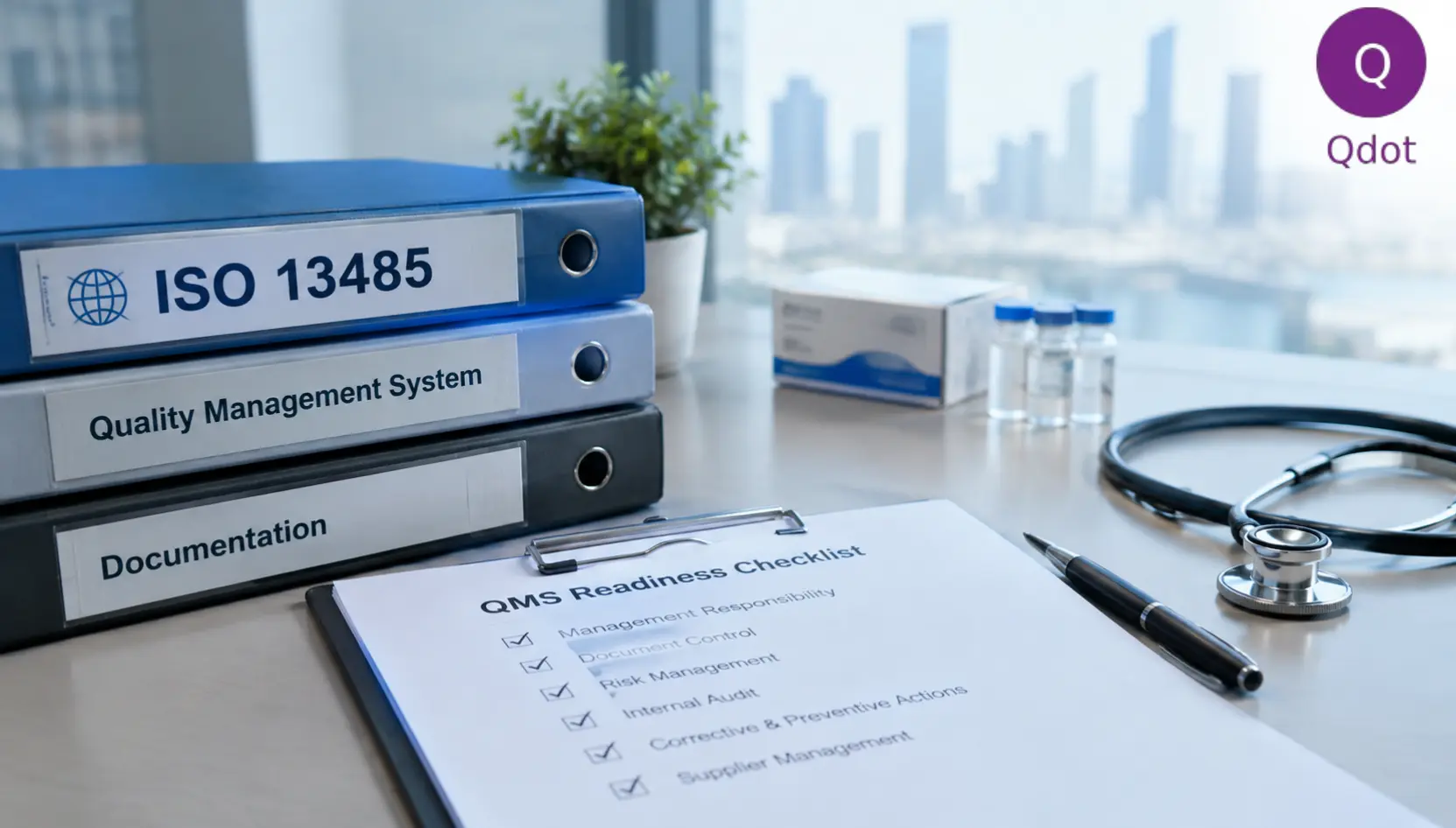
Medical device importers and distributors in Bahrain don't make the products they sell, but they still carry real quality responsibilities. They receive devices, store them, move them through the supply chain, and often deal directly with hospitals, clinics, and pharmacies when something goes wrong. This is where ISO 13485 Bahrain medical device distributors questions usually start — not "do we need a certificate," but "what should our quality system actually cover if we don't manufacture anything?"
This article looks at ISO 13485 from that angle. Not manufacturing. Not paperwork for its own sake. Just what a distribution or import business in Bahrain needs to have in place to run a reliable, well-controlled quality management system (QMS), and how to know if that system is ready for a certification audit.
Why ISO 13485 Matters Even If You Don't Manufacture Anything
ISO 13485 is built around the idea that quality has to be controlled at every stage a product passes through, not just at the factory. For an importer or distributor, that means the areas that matter most are the ones you actually touch: choosing and checking suppliers, receiving and storing stock correctly, keeping products identifiable, handling complaints, and reacting properly when something isn't right.
In Bahrain, the National Health Regulatory Authority (NHRA) oversees the registration of medical devices, and quality documentation from manufacturers is typically part of that process. That doesn't automatically mean every importer or distributor needs its own ISO 13485 certificate — this depends on the product, your role in the supply chain, your customers, and any contract or tender conditions you're working under. What's true for almost every distributor, regardless of certification status, is that having a properly structured QMS makes it much easier to meet buyer expectations, respond to audits, and catch problems before they become bigger ones.
What Does QMS Scope Mean for an Importer or Distributor?
QMS scope is simply a description of what your quality system actually covers — which activities, which locations, and which products.
For a distributor, scope usually needs to reflect things like:
- The specific business activities you carry out (importing, storage, distribution, and sometimes minor repackaging or labelling)
- Physical locations, including warehouses or storage facilities
- The product categories or device types you handle
- Who is responsible for quality decisions, and where those decisions get recorded
A common mistake is copying a scope statement written for a manufacturer, which pulls in production and design activities that simply don't apply. Your scope should describe your business as it actually runs — nothing more, nothing borrowed from a different type of organisation.
Supplier Controls: Why Your Quality Starts Before the Product Arrives
If you're a distributor, your biggest quality risk usually isn't something you do — it's something your supplier did or didn't do before the product reached you.
A working supplier control process generally covers:
- Evaluating suppliers before you start buying from them
- Approving suppliers based on criteria that make sense for your risk level
- Monitoring performance over time, not just at onboarding
- Purchasing controls that clearly state your quality requirements in orders or agreements
- Records showing evaluations, approvals, and any issues raised
- A way to capture supplier changes — new manufacturing site, new packaging, new authorised representative — that could affect the product
None of this needs to be complicated. A smaller distributor might manage two or three key suppliers with a simple spreadsheet and periodic reviews. A larger one handling dozens of product lines will need a more structured approach. The point is that the level of control should match your actual risk and responsibility.
Storage and Distribution: Where Most Quality Risks Actually Happen
This is usually the part of the QMS that gets the least attention on paper and causes the most real problems in practice.
Good storage and distribution control typically includes:
- Receiving checks — confirming the right product, quantity, and condition on arrival
- Storage conditions appropriate to the product (only apply specific limits like temperature ranges when they're a verified requirement for that particular device)
- Warehouse organisation that prevents mix-ups between similar products, batches, or expiry dates
- Handling procedures that protect packaging and product integrity
- Stock movement records, including FEFO (first-expiry, first-out) practices where relevant
- Transportation controls, especially if a third-party courier or freight company is involved
- Product protection during loading, unloading, and delivery
A distributor working out of a single warehouse in Bahrain still needs these controls — they just need to be sized to the operation. The goal isn't a thick manual. It's a set of practices your team can actually follow, with enough record-keeping to show they were followed.
Traceability: Knowing Where Every Device Came From and Went
Traceability means being able to answer, quickly, where a specific product came from and where it went.
For a distributor, this usually relies on a combination of:
- Product identification (model, batch, lot, or serial number, depending on the device)
- Supplier and purchase records
- Receiving records tied to that identification
- Distribution and delivery records showing which customer received which batch or unit
Not every device uses the same identification system — a reusable diagnostic instrument and a box of disposable test kits won't be tracked the same way. What matters is that your system fits the product, and that if a batch needs to be recalled or investigated, you can identify affected customers within a reasonable time, not after days of searching through invoices.
Handling Complaints the Right Way
A complaint isn't a nuisance — it's early warning information about a possible product or process problem.
A workable complaint process for a distributor covers:
- Receiving complaints through a clear channel (not scattered across emails and phone calls with no record)
- Logging every complaint, even minor ones
- Reviewing each complaint to decide if it's a one-off issue or a pattern
- Investigating where the cause isn't obvious
- Escalating to the manufacturer or supplier when the issue originates upstream
- Communicating outcomes back to the customer
- Keeping records of what was reported, investigated, and resolved
Any specific reporting obligation to a regulator or authority depends on the nature of the issue and the applicable requirements for that product — this should be confirmed against current NHRA guidance rather than assumed, since it can vary by device type and incident severity.
What Counts as a Nonconforming Product (And What To Do About It)
A nonconforming product is simply one that doesn't meet an expected requirement — damaged packaging, wrong labelling, expired stock, or a device that fails a basic check on receipt.
A practical process for distributors includes:
- Identify the product clearly (a tag, label, or system flag works fine)
- Segregate it where practical, so it can't accidentally be shipped
- Evaluate the issue — is it isolated, or does it point to a bigger supplier problem?
- Decide on disposition: return to supplier, destroy, rework where applicable, or release with justification
- Record what happened and why
- Communicate with the supplier or customer if needed
- Trigger corrective action if the same issue keeps showing up
This doesn't need a dedicated quarantine room in every case — even a clearly marked shelf or bin, backed by a simple log, can satisfy the intent for a smaller operation.
Corrective Action: Fixing the Cause, Not Just the Symptom
Corrective action gets a bad reputation because it's often treated as a form-filling exercise. Done properly, it's just structured problem-solving:
- Identify the problem clearly
- Find the real cause — not just the obvious first answer
- Decide what action will actually prevent it happening again
- Implement the action
- Check whether it worked after some time has passed
- Record the whole process
If a supplier keeps sending damaged shipments, the corrective action isn't "note it and move on" — it's understanding why (packaging, handling, transport) and fixing that specific cause, then confirming the fix worked on the next few deliveries.
Records That Prove Your QMS Actually Works
Auditors and customers don't take your word for it — they look at records. For a distributor, the records that typically matter include:
- Supplier evaluation and approval records
- Purchasing records
- Receiving and inspection records
- Storage and stock movement records
- Distribution and delivery records
- Traceability records
- Complaint records
- Nonconforming product records
- Corrective action records
- Training and competence records
- Internal audit and management review records
Not every business needs identical records. A three-person distribution office and a company running multiple warehouses across Bahrain will have very different volumes and formats — what matters is that the records match your actual scope, processes, and risk level, and that they're kept consistently.
Audit Readiness: Procedures Are Not Enough
Having a procedure document for every process is only half the job. An auditor also needs to see evidence that the process is actually being followed day to day. This is where many distributors get caught out — the manual looks fine, but the records don't back it up.
| QMS Area | Example Evidence |
|---|---|
| Supplier control | Approved supplier list, evaluation forms, performance reviews |
| Storage and distribution | Receiving checks, stock movement logs, transport records |
| Traceability | Batch, lot, or serial records; distribution/delivery records |
| Complaints | Complaint log, investigation notes, corrective actions taken |
| Nonconforming product | Identification and segregation records, disposition decisions |
| Corrective action | Root cause analysis, action plan, effectiveness check |
| Training | Training records, competence evidence |
| Internal audit | Audit schedule, checklists, findings, closure evidence |
| Management review | Meeting minutes, decisions, follow-up actions |
Exactly which evidence applies depends on which processes are inside your QMS scope — a distributor that doesn't handle repackaging, for example, won't need records for a process it doesn't perform.
Internal Audits and Management Review Before Certification
Internal audits and management review are the two activities that catch gaps before an external auditor does.
Internal audit should check whether procedures are being followed in practice, not just whether they exist. This means looking at actual receiving records, actual complaint files, actual supplier evaluations — and recording any gaps found, with a plan to close them.
Management review is more than a meeting. It's a structured look at how the QMS is performing: complaint trends, supplier issues, audit findings, corrective action status, and whether resources or process changes are needed. The output should be documented decisions, not just discussion notes.
Businesses preparing for external certification, or reviewing their setup against the ISO 13485 certification requirements for Bahrain, often find that internal audit and management review are the two areas most likely to be underdeveloped, simply because they get postponed until closer to the audit date.
A Quick QMS Readiness Checklist for Bahrain Distributors
Before booking a certification audit, it helps to honestly answer these questions:
- Is your QMS scope written to match what your business actually does?
- Are your key suppliers evaluated, approved, and monitored?
- Are storage and distribution processes documented and followed?
- Can you trace a product from a specific supplier to a specific customer?
- Are complaints logged, reviewed, and closed with evidence?
- Is there a working process for nonconforming products?
- Are corrective actions tracked through to a completed, verified fix?
- Do your records match the processes in your QMS scope?
- Have internal audits actually been completed, with findings recorded?
- Has management reviewed the QMS with documented outcomes?
If several of these are "not yet," that's not unusual — it's simply a sign of where to focus before an audit rather than during one.
Where ISO 13485 Consultancy Fits In
Consultancy support tends to add the most value in a few specific areas for importers and distributors:
- Defining a scope statement that reflects the real business, not a manufacturer's template
- Running a gap assessment against current practices
- Building supplier evaluation and monitoring processes that fit the company's risk level
- Setting up practical storage, distribution, and traceability records
- Preparing internal audit and management review processes
- Getting documentation and evidence ready before an external audit
It's worth being clear on one point: a consultancy like Qdot International supports the build-out and readiness of the QMS — the certificate itself is issued by an independent, accredited certification body, not by the consultancy. Qdot's role in ISO consultancy for Bahrain businesses is to help get the system genuinely working before that external audit takes place, which is usually what determines how smoothly certification goes.
If you'd like a clearer picture of where your own QMS stands, requesting an ISO 13485 distributor-QMS readiness review is a practical next step. It gives you a straightforward view of what's already working, what needs attention, and what evidence an auditor would actually expect to see — before you commit to a certification timeline.
FAQs
No. Requirements depend on the product, your role in the supply chain, your customers, and any contract or tender conditions. Many distributors pursue certification because it supports buyer trust and streamlines audits, not because it's a blanket legal requirement for every business.
Not necessarily. This depends on your specific responsibilities — for example, whether you act as an authorised representative, repackage products, or hold direct quality obligations to customers. It's worth checking this against your actual role rather than assuming either way.
Manufacturers must cover design and production controls. Distributors focus on supplier control, storage, distribution, traceability, complaints, and corrective action — the parts of the standard relevant to handling a finished product rather than making one.
Typically supplier approval records, receiving and storage records, distribution records, complaint logs, nonconforming product records, and evidence of internal audits and management review.
No. Qdot provides consultancy and implementation support to help a company build and prepare its QMS. Certification itself is carried out by an independent certification body, following its own audit process — see our overview of the ISO certification process in Bahrain for how that stage works.