 UAE
UAE
 Qatar
Qatar
 Pakistan
 KSA
KSA
 Oman
Oman
 Kuwait
 Bahrain
For a Saudi dates exporter, the real question is rarely 'Which certificate should we get?' A better question is: what does the buyer expect, what can go wrong in our process, and what evidence will prove that the controls work?
Saudi dates have a strong identity in regional and international markets, but exporting successfully takes more than an attractive product and a competitive price. Buyers may want evidence that food-safety risks are understood, suppliers are controlled, hygiene is consistent, batches can be traced, and - where relevant - Halal requirements are properly managed.
That is why ISO 22000, HACCP and Halal often appear in the same buyer questionnaire or tender. They can sound like three competing certification routes. They are not. Each answers a different question, and the controls overlap more than many companies expect.
HACCP is about identifying significant food-safety hazards and deciding how they will be controlled. ISO 22000 puts those hazard controls inside a broader food safety management system. Halal assurance looks at a different dimension: whether relevant ingredients, materials, handling and processing remain consistent with the applicable Halal requirements.
Three Systems, Three Different Jobs
For a dates processor or exporter, it helps to stop thinking in terms of certificates for a moment and look at what each approach is trying to achieve.
| Area | HACCP | ISO 22000 | Halal Assurance |
|---|---|---|---|
| Main purpose | Control food-safety hazards | Manage food safety through a structured FSMS | Demonstrate Halal conformity of products and processes |
| Primary focus | Hazard analysis and control measures | PRPs, HACCP principles, communication, traceability and improvement | Ingredients, suppliers, processing, handling and Halal evidence |
| Supplier control | Food-safety risk from supplied materials | Formal supplier management within the FSMS | Halal status and supporting evidence where relevant |
| Traceability | Supports investigation and recall | Formal system for product and material traceability | Supports material identity and Halal integrity |
| Typical reason to use | Focused hazard-control requirement | Broader certifiable food-safety management system | Buyer or market asks for Halal assurance |
The most important relationship is between HACCP and ISO 22000. ISO 22000 already incorporates HACCP principles; it does not create a separate hazard-control system beside HACCP. ISO describes the standard as combining prerequisite programmes, system management, communication and HACCP principles. In other words, a company moving toward ISO 22000 should normally strengthen and formalize its HACCP-based controls rather than inventing another set of controls from scratch.
HACCP itself is internationally rooted in the Codex Alimentarius General Principles of Food Hygiene (CXC 1-1969). Codex separates good hygiene practices from the HACCP system while showing how the two work together. That distinction matters in a dates facility because a HACCP plan cannot rescue weak everyday hygiene.
What This Looks Like in a Dates Packing Operation
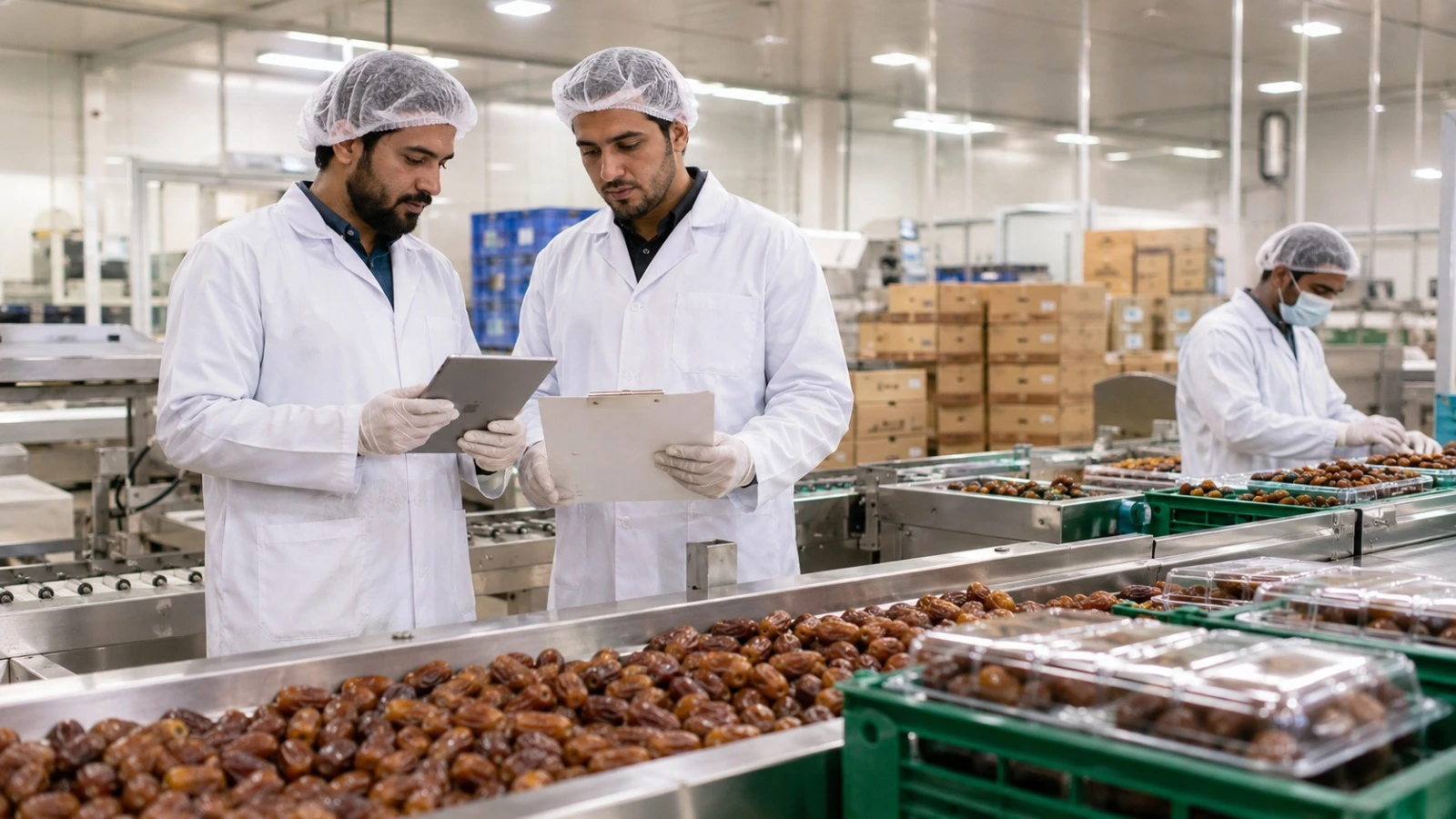
Imagine a facility receiving dates from several farms or suppliers. Depending on the product, the dates may be inspected, cleaned, sorted, graded, pitted, filled, coated or packed before storage and dispatch. Some businesses handle only plain whole dates; others produce premium gift boxes or value-added products containing chocolate, nuts, dairy ingredients, flavourings or other materials.
The same day-to-day record can support more than one assurance objective. A supplier approval record can support ISO 22000. Information about incoming materials may feed the HACCP hazard analysis. If a value-added ingredient has a Halal concern, the same supplier file may also carry the Halal evidence needed for that ingredient. A batch code can support recall traceability and, at the same time, help prove which materials were used in a Halal-controlled product.
This is the practical advantage of integration: one controlled operation, with the requirements mapped onto it, instead of three separate folders that nobody uses until an audit is announced.
1. Supplier Control Starts Before the Dates Reach the Line
Food-safety control begins well before packing. An exporter should know who supplied the dates, what specification was agreed, how incoming lots are identified, what acceptance checks are performed, and what supporting information is needed for the intended buyer.
- Approved supplier status and periodic supplier review
- Raw material, ingredient and packaging specifications
- Incoming lot, farm or supplier identification where relevant
- Receiving inspection and acceptance criteria
- Certificates or laboratory results when they are required by risk, specification or buyer
- Supplier performance, complaints and corrective actions
- Halal documentation for ingredients or materials where it is relevant
The level of control should reflect the actual risk. A supplier providing plain harvested dates does not create exactly the same questions as a supplier providing a filling, coating or processing aid. The point is not to collect the largest possible file. It is to know which evidence matters and why.
2. Traceability Should Follow the Product, Not Just the Invoice
A buyer may ask whether a carton can be traced back to a production lot. A well-designed system should usually go further. It should connect the finished product with the relevant incoming lots, processing or packing information and dispatch records.
A practical traceability chain might look like this: supplier or farm -> incoming lot -> processing/packing batch -> finished-product lot -> storage -> customer dispatch.
That becomes especially important when a facility handles several varieties, multiple farms, different pack sizes or value-added products. A batch number is only useful if the team can use it quickly. Periodic traceability exercises or mock recalls are a good way to discover weak links before a real complaint or withdrawal forces the issue.
3. Hygiene and Prerequisite Programmes Provide the Foundation
One of the most common mistakes in food-safety projects is spending too much time debating critical control points while basic hygiene still varies from shift to shift. Good hygiene practices and prerequisite programmes create the operating conditions on which the HACCP study depends.
- Personnel hygiene and staff practices
- Cleaning and sanitation
- Pest management
- Water quality where water is used in the process
- Maintenance and food-contact surface condition
- Chemical, waste and foreign-material controls
- Storage, transport and dispatch hygiene
- Training and supervision of relevant employees
Two exporters can sell a similar box of dates and still need different controls. One may only sort and pack whole dates. Another may wash, pit, fill, coat and individually wrap them. Their hazard analyses should not be carbon copies. The system has to follow the real process.
4. HACCP Should Reflect What Actually Happens on the Floor
A useful HACCP study starts by walking the process, not by opening a template. The team confirms the flow, identifies relevant biological, chemical and physical hazards, evaluates their significance, chooses suitable control measures, and decides how those controls will be monitored and verified.
For dates, the assessment may need to consider risks associated with incoming agricultural material, pest activity, storage, foreign materials, cleaning activities, packaging, additional ingredients or processing steps. Which hazards matter - and which controls are critical - depends on the product and process. Declaring every step a critical control point makes the system hard to operate; overlooking a significant hazard creates a more serious problem.
Production staff should be involved. They often know about variations, shortcuts and seasonal realities that never appear in a procedure written in an office.
Saudi regulatory expectations also need to be checked for the specific activity. In a 2024 enforcement update, the Saudi Food and Drug Authority described inspections of food establishments under its supervision that included checking the existence and effectiveness of HACCP systems and tracking systems. That is useful context, but exporters should still verify the rules applying to their own facility and product rather than treating one certification route as universally mandatory.
5. ISO 22000 Adds the Management-System Layer
If HACCP is the operational engine of food safety, ISO 22000 provides the management structure around it. It connects hazard control with leadership, responsibilities, communication, documented information, supplier management, competence, traceability, emergency arrangements, verification, internal audit, corrective action, management review and continual improvement.
That broader structure can be useful for exporters dealing with larger customers, formal vendor-registration programmes, multiple sites or buyers that specifically request a certified food safety management system.
As of August 2026, ISO still lists ISO 22000:2018 as the published edition and indicates that a revision is in progress. A company beginning a new certification project should therefore confirm the current applicable edition at the time the project starts.
It is also worth being precise about roles: ISO develops standards; it does not certify companies. Where third-party certification is selected, the audit and certification decision belong to the independent certification body.
6. Where Halal Fits for Dates
Plain dates are plant-based, so the Halal side of a simple dates operation may be relatively straightforward. But the picture changes quickly when the product becomes more complex. Chocolate coatings, fillings, dairy ingredients, flavourings, glazing or processing aids, contract packing and shared equipment can all create additional questions that need to be understood.
Halal assurance can therefore involve ingredient and supplier review, supporting certificates where applicable, segregation, cleaning, storage, processing and label controls. It is an assurance layer with a different objective from HACCP, even though some of the evidence - particularly supplier records and traceability - may be shared.
The Saudi Food and Drug Authority's Saudi Halal Center provides Halal certification services and describes its assessment and audit process. For an exporter, however, the destination market still matters. Before paying for a particular route, confirm what the buyer or destination market recognizes and what evidence it expects.
For implementation support, see Qdot's HALAL Consultancy In Saudi Arabia.
Do Not Build Three Versions of the Same Evidence
An integrated system should reduce duplication. One supplier register, for example, can show the product supplied, approval status, food-safety risk, required test evidence, Halal documentation where relevant, review date and supplier performance. One traceability system can support food-safety investigations, customer complaints and Halal material identification.
This matters because systems fail when employees have to choose between several forms that ask for almost the same information. Shared evidence is easier to maintain and much easier to explain during a customer or certification audit.
Which Route Should a Saudi Dates Exporter Choose?
There is no sensible one-size-fits-all answer. Start with the buyer, the product and the export market, then choose the assurance route.
| Business Situation | Practical Route to Consider |
|---|---|
| Buyer asks for a documented HACCP system | Build and verify HACCP against the actual product and process. |
| Buyer specifically asks for HACCP certification | Confirm the expected scheme and certification-body acceptance before appointing a provider. |
| Buyer requires ISO 22000 certification | Implement the full ISO 22000 FSMS and prepare for independent third-party certification. |
| Buyer or export market asks for Halal evidence | Confirm the accepted Halal scheme, certificate and issuing body before starting. |
| Business produces filled or coated dates | Combine food-safety controls with ingredient-specific and Halal controls where relevant. |
| Different buyers ask for different assurances | Create an integrated system and map each buyer requirement to shared controls and evidence. |
| Buyer requirement is unclear | Get the requirement in writing before spending on certification. |
If HACCP is the selected route, Qdot's HACCP Certification Readiness Support in Saudi Arabia provides further information on preparation and implementation support.
Questions to Ask the Buyer Before Choosing a Route
A short conversation with the buyer can save weeks of work and unnecessary certification cost. Ask these questions before the project scope is fixed:
- Do you require HACCP, ISO 22000, Halal certification, or a combination?
- Do you need third-party certification, or evidence of an implemented system?
- Do you specify a particular certification or accreditation arrangement?
- Which production site and which products must appear within the scope?
- Are there destination-country Halal recognition requirements?
- What supplier certificates, declarations or product specifications must be provided?
- What laboratory testing or certificates of analysis are expected for the product?
- What traceability information must appear on the product or supporting documents?
- Are there buyer-specific packaging, labelling or shelf-life requirements?
- Will the buyer require an audit report, supplier questionnaire or additional approval visit?
Common Mistakes That Look Small Until an Audit
The most expensive problems are often not complicated technical failures. They are mismatches between what the company says it does and what actually happens.
- Using a generic HACCP plan that does not match the facility or product flow
- Approving suppliers without meaningful supporting evidence
- Maintaining batch codes that cannot actually trace material forward and backward
- Obtaining a certificate without confirming that the buyer will accept it
- Assuming one Halal certificate will automatically be accepted by every destination market
- Ignoring outsourced storage, transport or contract processing
- Failing to update the hazard analysis when a new filled, coated or value-added date product is introduced
- Treating certification as a substitute for product, labelling or destination-market requirements
Build the System Around the Export Route
For a Saudi dates exporter, the cleanest starting point is the product and customer. List the products being exported. Map the suppliers and process steps. Understand the hazards. Check whether the hygiene controls really work. Test traceability. Then confirm the buyer's food-safety and Halal expectations before selecting a certification route.
ISO 22000, HACCP and Halal should not become three isolated sets of documents. When they are designed properly, they can share supplier controls, traceability, hygiene records and evidence while still serving different assurance purposes.
Qdot supports Saudi food businesses with gap analysis, system development, implementation guidance, training, internal audit and certification-readiness preparation. Qdot acts as a consultancy and training support provider; it does not make the independent certification decision.
Planning to export Saudi dates or enter a new buyer market? Request a food-safety and export-readiness gap review before selecting the certification route. Identify buyer expectations and priority gaps before certification or customer approval.