 UAE
UAE
 Qatar
Qatar
 Pakistan
 KSA
KSA
 Oman
Oman
 Kuwait
 Bahrain
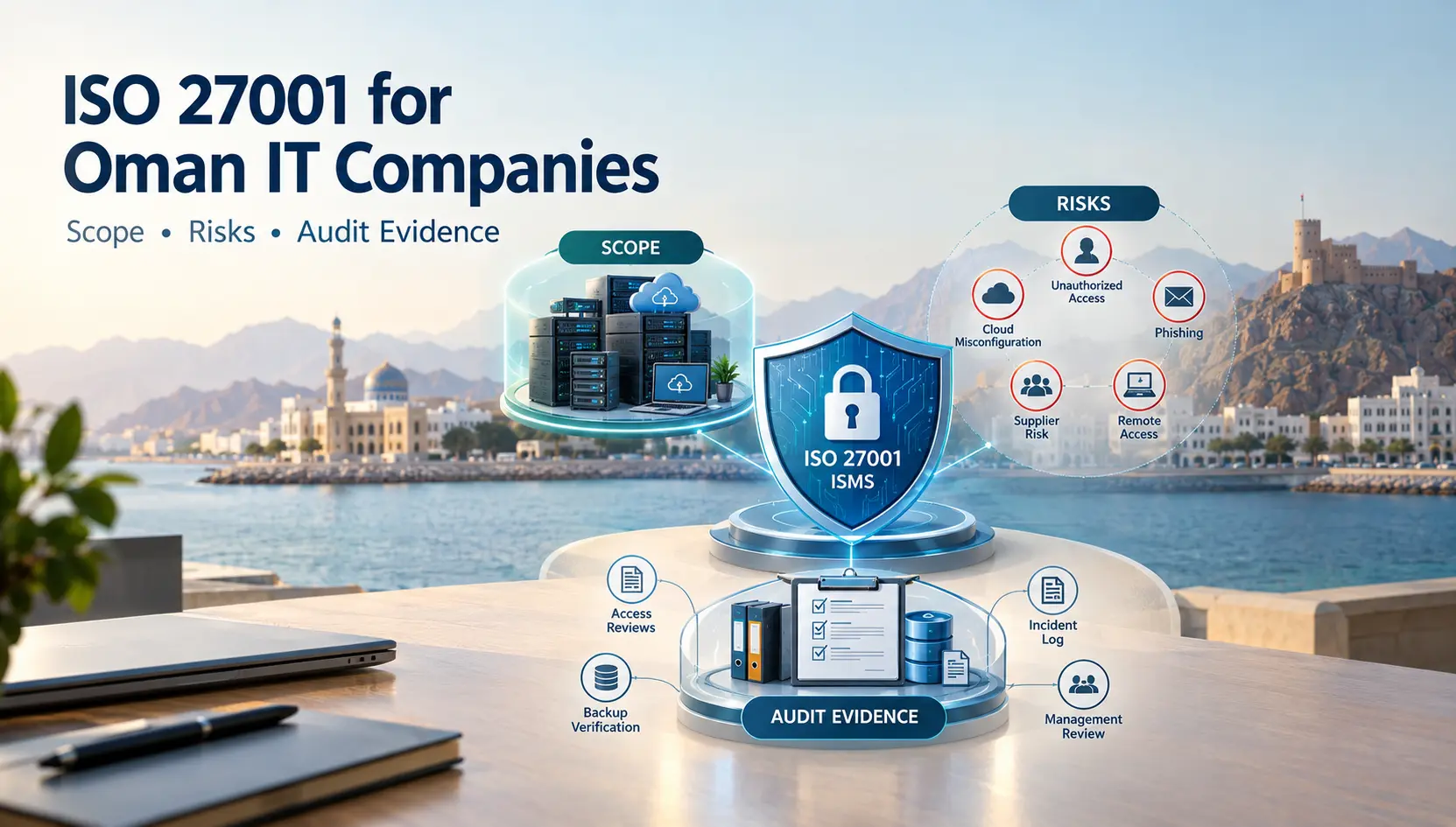
If you run an IT company, software business, or service company in Oman that handles customer data, you've probably had this conversation before. A client's security team asks about your controls. A tender mentions ISO 27001. Or you simply look at how much sensitive information now flows through your systems and decide it's time to get organised.
This isn't a basic introduction to ISO 27001. It focuses on what matters once you're seriously considering it: defining your scope, understanding the risks that apply to IT and service businesses, and knowing what an auditor expects as proof your controls work in real life.
Why ISO 27001 Matters for IT Companies in Oman
ISO 27001 isn't a legal requirement for every IT or service company in Oman. Whether it makes sense depends on your customers, contracts, and how much risk you're carrying.
IT and service companies handle things that are easy to underestimate because they aren't physical: customer databases, source code, admin credentials, cloud configurations, and support tickets full of confidential detail. Lost or misused, the cost is real — a client relationship, a renewal, or your reputation in a small market.
ISO 27001 is an international standard for building an information security management system, or ISMS: a structured way to work out what needs protecting, decide how to protect it, and prove the protection works. For many IT companies in Oman, interest starts with a client or tender asking for it; for others, it formalises practices that grew informally as the business scaled.
What Does ISO 27001 Scope Actually Mean?
In short: scope means defining which services, information, systems, and parts of your business the ISMS covers — and which ones it doesn't.
This sounds simple, but it's where many companies go wrong: covering the whole organisation when only part handles sensitive data, or leaving out an office or outsourced activity that should clearly be included.
A workable scope statement should answer:
- Which services are included (development, hosting, IT support, and so on)
- Which offices or locations are covered
- Which departments and employees fall inside the ISMS
- Which systems, applications, and technology are in scope
- Whether outsourced work, cloud platforms, and third parties are included
If your documented scope doesn't match reality, an auditor will notice — and it usually shows up as a nonconformity. It also causes confusion internally, since an unclear scope leads to a risk assessment that's strong in some areas and blind in others.
Setting Clear Service and Information Boundaries
Scope gets easier once you separate four things: what your company provides, what information it handles, what systems support that service, and what parts of the business sit inside the ISMS.
Take a managed IT service provider offering remote support and monitoring. The information handled includes client credentials, network diagrams, and ticket data. The systems are the monitoring tool, ticketing platform, and VPN used to reach client networks — all inside the ISMS. The client's own internal systems aren't, but how you access and protect that connection is.
A software company works differently: building and hosting an application, handling user data, source code, and database credentials. Whether HR or finance are included should be a deliberate decision, not an afterthought.
Information Security Risks Every IT and Service Company Should Know
Generic risk lists don't help much, so it's worth thinking about how these actually show up day to day:
| Risk | How it shows up in practice |
|---|---|
| Unauthorised access | A former employee, or departed client contact, who still has a login. |
| Weak credentials and excessive permissions | Support staff given wider admin rights than a ticket needs. |
| Remote access risks | Engineers connecting to client networks from personal laptops or unsecured Wi-Fi. |
| Cloud configuration mistakes | A storage bucket or SaaS setting left open by accident. |
| Supplier and third-party risk | An outsourced helpdesk or vendor whose practices are weaker than yours. |
| Data loss | Files deleted with no clear backup owner, or nobody checking backups work. |
| Malware and phishing | Shared inboxes and admin credentials are common, repeated targets. |
| Service disruption | Downtime at a service provider affects every client relying on it that day. |
| Unprepared incident response | Nobody is sure who reports what, or what happens next. |
| Lost devices and poor monitoring | Cached VPN access on a lost laptop, or unusual activity nobody notices for weeks. |
Cloud Risks You Need to Think About
Most IT and service companies in Oman now run on some mix of cloud platforms and hosted services. That doesn't create risk on its own, but part of your risk picture now depends on infrastructure you don't fully control.
Worth reviewing: what the provider is responsible for versus what you are (shared responsibility), who holds admin access to your cloud tenant, whether default settings were ever checked, how data is classified, what happens during a provider outage, and whether you can see login attempts or configuration changes when they happen.
This isn't about specific Omani cloud regulations — the point is simpler. Cloud use needs to sit inside your ISMS, not outside it as "the provider's problem."
Managing Supplier and Third-Party Risk
External IT providers, cloud platforms, software vendors, outsourced helpdesks, and hosting partners can all affect your information security, even though you don't control them directly.
The practical question is whether you know what access each supplier has, what data they can see, what the contract says about their security responsibilities, and whether anyone checks in on them after signing. A common gap is a contract reviewed once and never looked at again — usually the first thing an auditor asks about.
Access Control That Holds Up Under Audit
Good access control isn't complicated in principle. What matters is role-based access instead of ad hoc grants, privileged accounts kept separate from everyday ones, a clear process for removing access on someone's last day (owned by a specific person, not left to memory), regular access reviews, and multi-factor authentication where it makes sense — particularly for remote access and admin accounts.
An auditor typically wants more than a policy: a current user list matched against staff records, examples of access reviews carried out, and proof that access was removed when someone left.
Getting Ready to Handle a Security Incident
A written incident response policy is a starting point, not the finish line. What actually gets tested — by a real incident or an auditor's questions — is whether people know what to do.
Practical readiness looks like this: staff know how to report something that looks wrong, someone is clearly responsible for judging how serious it is, there's a basic response approach for common scenarios like a compromised account or phishing, incidents get logged with what was done, and afterwards there's a review of what should change. One tabletop exercise a year tends to reveal more gaps than any policy document.
Backup and Business Continuity: Two Sides of the Same Coin
Information security isn't only about stopping unauthorised access. It's also about making sure information and services stay available when something goes wrong.
That means backups that run and are actually checked, not just scheduled and forgotten; someone who owns backups as a responsibility; restore tests carried out from time to time, because an untested backup is a guess, not a plan; and recovery steps for your most critical systems.
For companies where uptime is the whole business — most IT and service providers — it's worth understanding how ISO 27001 connects to ISO 22301 business continuity management. ISO 27001 protects information; ISO 22301 keeps operations running during disruption. Different questions, but the two usually support each other.
What Evidence Do Auditors Actually Look For?
In short: ISO 27001 audits don't stop at checking whether policies exist. They check whether an organisation can show its controls are actually being used.
An auditor is more likely to ask "show me" than "tell me." A well-written policy with no proof anyone follows it is usually a gap, not a strength.
Two IT companies with different services and risk profiles will end up with different evidence, even under the same standard. There's no single fixed list every organisation must produce — it depends on your scope, your risks, and the controls you've actually put in place.
Why Internal Audit Matters Before Certification
Internal audit is your own check before an external auditor's check. Its purpose is to find gaps, test whether the ISMS is really being used rather than just documented, and give management a realistic picture before certification.
In practice, that means checking whether written procedures match what people actually do, reviewing a sample of records like access reviews and incident logs, writing down findings clearly, and tracking corrective actions to completion. Companies that take internal audit seriously walk into certification with far fewer surprises.
Management Review: More Than a Meeting on Paper
Some companies hold a management review, produce minutes, and move on. The actual point is a genuine, periodic look by leadership at whether the ISMS is working and what needs to change.
A useful review covers what audits found, how security controls performed, what incidents happened and what they cost, whether risks have shifted, progress on corrective actions, and whether the team has the resources it needs. What separates a real review from a formality is whether it leads to decisions — and whether someone follows up on them.
A Practical Readiness Checklist
Before booking a certification audit, it's worth checking where things stand:
- ☐ Scope is documented and matches reality
- ☐ Risk assessment covers your real services, systems, and data
- ☐ Access is role-based, reviewed regularly, and removed when people leave
- ☐ Key suppliers have been assessed for security risk
- ☐ Incident response roles are known to staff, not just written down
- ☐ Backups are monitored and restore tests have been carried out
- ☐ Internal audit has taken place and findings are tracked
- ☐ Management review included real discussion, not just a record
- ☐ Staff have had security awareness training
- ☐ Policies are approved, reviewed, and version controlled
Not exhaustive — but if several items are unchecked, that's usually where to start.
Where ISO 27001 Consultancy Support Can Help
A lot of this can be worked out internally, especially in a smaller IT team. But most companies find outside support speeds things up: defining a scope that holds up under audit, running a gap assessment, structuring risk assessment around your actual services rather than a generic template, building documentation people will realistically use, and supporting internal audit and management review before the certification audit.
It's worth being clear about roles. A consultancy like Qdot's ISO 27001 certification consultants in Oman helps you build and prepare the ISMS. Certification itself is carried out separately, by an independent, accredited certification body that decides whether your system meets the standard. If you're also weighing up other management system standards, Qdot's wider ISO consultancy support in Oman covers that broader picture too.
Getting a Clearer Picture Before You Commit
If you're weighing up whether your current scope, risk assessment, and evidence would hold up under an ISO 27001 audit, it usually helps to get an outside view first. Request an ISO/IEC 27001 scope and audit-evidence review to find out where your IT or service business stands today, and what — if anything — needs attention before you go further.