 UAE
UAE
 Qatar
Qatar
 Pakistan
 KSA
KSA
 Oman
Oman
 Kuwait
 Bahrain
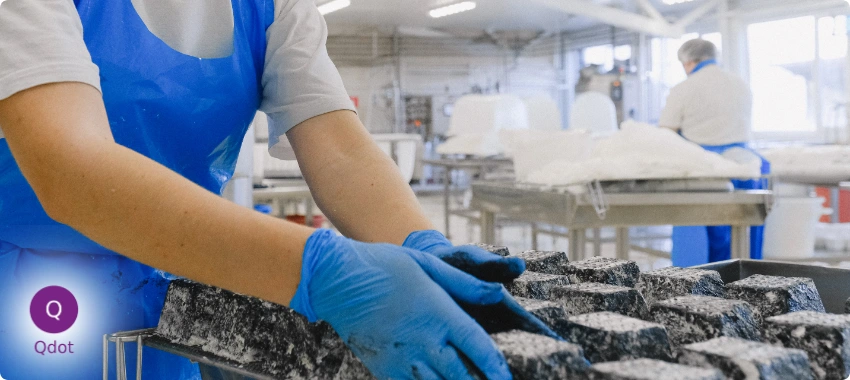
Qdot provides GMP consultancy in Saudi Arabia for manufacturers who need a Good Manufacturing Practice system that works on the production floor, not only on paper. Our consultants build the quality system, prepare the documentation, train your staff and get the facility genuinely ready before an independent certification body carries out the GMP certification in Saudi Arabia. Whether your business produces cosmetics, food, nutraceuticals, packaging for regulated products or pharmaceutical support activities, the objective stays the same: consistent, controlled production that protects the end user and holds up under a real audit rather than a rehearsed one.
What GMP Consultancy in Saudi Arabia Actually Covers
Good Manufacturing Practice is a set of controls over how a product is made, stored and moved, not how it performs once it reaches the shelf. It covers facility design, equipment maintenance, personnel hygiene, raw material handling, in-process checks, packaging, storage conditions, traceability, and how complaints or recalls are managed. A GMP consultant works on the preparation side of this picture. Qdot's role is to help your team understand what these controls mean for your specific product line, convert them into procedures your staff can actually follow, and build the evidence an auditor will expect to see. The certification decision itself always rests with an independent, accredited certification body once the system is ready for review.
Why GMP Has Become a Business Priority for Saudi Manufacturers
Saudi Arabia's food, cosmetics and pharmaceutical manufacturing base is growing quickly. Vision 2030 and the National Industrial Development and Logistics Program have set a target to localize a substantial share of the pharmaceutical industry's value by 2030, and similar momentum is visible in food processing and cosmetics manufacturing across industrial hubs such as Riyadh, Jeddah, Dammam, Jubail and Yanbu. As more production moves onto Saudi soil, buyers, hospitals, distributors, retailers and government procurement channels are paying closer attention to how products are actually manufactured, not only how they are labelled. GMP certification in Saudi Arabia has shifted from an optional credential to a practical requirement for vendor registration, retail listing, tender prequalification and access to GCC and international export markets. For pharmaceutical manufacturers, the Saudi Food and Drug Authority requires GMP compliance as part of facility licensing, with expectations informed by WHO and international frameworks such as PIC/S. For cosmetics, food and supplement producers, an independently audited GMP certification, most commonly ISO 22716 for cosmetics, is what buyers and regulators now look for as evidence of controlled production.
Who Needs GMP Certification in Saudi Arabia
GMP certification is no longer limited to large pharmaceutical plants. In Saudi Arabia, the requirement now reaches a wider group of manufacturers, processors and suppliers, including:
- Cosmetics and personal care manufacturers producing under ISO 22716 principles, covering skincare, haircare, fragrances and toiletries.
- Food and beverage processors, co-packers and ingredient suppliers, where hygiene and contamination control decide product safety. Many of these businesses also work with Qdot on ISO 22000 consultancy in Saudi Arabia or HACCP consultancy in Saudi Arabia alongside GMP.
- Nutraceutical, dietary supplement and herbal product manufacturers supplying pharmacies, retailers and export markets.
- Pharmaceutical support operations, including packaging, labelling, warehousing and contract manufacturing activities that sit alongside SFDA-regulated drug production.
- Private label brands, distributors and medical device suppliers whose contract manufacturers must demonstrate GMP-controlled production before a listing or tender is approved. Medical device manufacturers may also need ISO 13485 consultancy in Saudi Arabia alongside GMP-style controls.
The Core Requirements Behind Every GMP System
These requirements repeat, in some form, across WHO GMP guidance, ISO 22716 and the frameworks SFDA references for regulated manufacturing:
- Premises and equipment. Facility layout, cleaning validation, and equipment maintenance and calibration that prevent contamination and product mix-ups.
- Personnel hygiene and training. Gowning, handwashing, health checks and documented competency for anyone entering production, storage or packing areas.
- Documentation and batch records. SOPs and production records that show what was made, by whom, when and under what conditions.
- Material and supplier control. Qualification of raw material suppliers, incoming inspection and traceability from receipt through to finished goods.
- Process and cleaning validation. Evidence that critical processes and cleaning methods consistently deliver the required result, batch after batch.
- Deviation, complaint and recall handling. A documented route for investigating problems, correcting them, and withdrawing product if it is ever necessary.
- Self inspection and management review. Internal audits and leadership review that catch weaknesses before an external auditor does.
How Qdot's GMP Consultancy Works, Step by Step
Qdot follows a structured route built around our documented consultancy methodology, adapted to the risk level of your product:
- Initial scoping call to confirm your product category, site, production volume, existing documentation and target certification.
- Gap analysis comparing current practice against the GMP requirements relevant to your product line, whether cosmetics, food, supplements or pharmaceutical support activities.
- Documentation development, including the GMP manual, SOPs, cleaning and sanitation procedures, hygiene protocols and record templates built around how your facility actually runs.
- Implementation support to help your team put the system to work, generate genuine batch, cleaning and hygiene records, and close early gaps.
- Staff and internal auditor training, so people understand their role in the system rather than treating it as extra paperwork.
- Internal audit and corrective action, followed by a management review before the external certification audit takes place.
- Coordination with your selected independent certification body through the audit itself, with Qdot available to support your team on the day.
Documentation and Records Your GMP System Should Produce
By the time your facility is ready for audit, you should have a working set of records in place, not a folder assembled the week before:
- GMP manual and a clearly defined scope statement
- SOPs for production, cleaning and sanitation
- Personnel hygiene, training and competency records
- Batch, production and storage records with traceability
- Supplier and raw material qualification records
- Calibration and equipment maintenance logs
- Deviation, corrective action, complaint and recall procedures
From Consultancy to Certification: How the Independent Audit Works
Once the internal audit and management review are complete, your organization moves into the certification stage. An independent, accredited certification body reviews your documentation and scope, then conducts an on-site audit of your facility, checking hygiene practices, production controls, storage conditions and the records behind them, alongside interviews with your staff. Depending on the certification scheme, this may run as a single comprehensive audit or as a documentation review followed by an implementation audit. Any non-conformities raised must be closed with evidence before certification is confirmed. Qdot's consultants can attend this audit alongside your team, helping you present evidence clearly and respond to auditor questions without disrupting production. The certification body, not Qdot, makes the final decision, and no consultancy can guarantee a specific outcome. What we can guarantee is that your organization walks into that audit properly prepared.
Common Implementation Challenges We Help Saudi Manufacturers Solve
Most GMP projects in Saudi Arabia run into a similar set of obstacles. Recognizing them early keeps the project on schedule:
| Common Challenge | How It Is Typically Resolved |
|---|---|
| Facility layout was not designed with GMP flow in mind | A practical, phased corrective plan instead of a full facility redesign |
| Hygiene practices exist but were never documented | Turning existing habits into SOPs, checklists and training records |
| High staff turnover disrupts training records | A simplified, repeatable training and record-keeping system |
| Confusion between SFDA regulatory steps and certification body audits | Qdot clarifies which body does what and coordinates both tracks |
| Supplier and raw material records are incomplete | Building a workable supplier qualification and incoming inspection process |
Why Saudi Businesses Choose Qdot for GMP Consultancy
Qdot has supported more than 4,000 clients and completed over 1,000 successful certifications since 2016 across Saudi Arabia, the UAE, Qatar and the wider GCC, with around 95 percent of clients staying with us long-term into their surveillance and recertification cycles. Qdot itself operates a certified ISO 9001:2015 quality management system and holds ISO 20700:2017 certification, the international standard for management consultancy services, so our own delivery is held to the same discipline we ask clients to build. We work only with IAF-accredited certification bodies, and we hold no commercial arrangement that would bias which body we recommend. Every GMP project produces documentation built around your actual operation rather than a shared template, and our consultants attend Stage 1 and Stage 2 audits where the project scope requires it. You can review our full track record on the Why Qdot page and see examples of completed projects in our case studies.
Consultancy and Certification Are Two Separate Roles
Qdot is a GMP consultancy and training support provider. We do not issue accredited GMP certificates directly, and we are not a certification body. Certification is granted by an independent, accredited body after your organization successfully completes the required audit. Keeping this line clear protects the value of the certificate itself, since a consultancy that also certified its own clients would create an obvious conflict of interest. Qdot's job is to prepare your system, coordinate with the certification body you choose, and support you through audit readiness and any findings that need closing.
Start Your GMP Consultancy Project in Saudi Arabia
Share your product category, site location, employee count, existing documentation and target certification date with Qdot International, and our team will propose a realistic route through gap analysis, documentation, implementation and audit readiness. We support clients across Riyadh, Jeddah, Dammam, Al Khobar and other Saudi cities through onsite, remote or hybrid delivery, and can support a broader ISO consultancy in Saudi Arabia scope if your business needs more than one standard.
FAQs
GMP consultancy is the preparation work: gap analysis, documentation, training, implementation and internal audit that gets your facility ready. GMP certification is the outcome, awarded by an independent, accredited certification body after a formal audit confirms your system meets the requirements. Qdot handles the first part; the certification body handles the second.
It depends on the product. Pharmaceutical manufacturers must meet SFDA GMP requirements as part of facility licensing. Cosmetics, food and supplement producers are not always legally required to hold a specific GMP certificate, but most buyers, retailers, hospitals and export markets now expect one before approving a supplier.
SFDA's expectations for regulated manufacturing draw on international frameworks such as WHO and PIC/S guidance. For pharmaceutical facilities, SFDA carries out its own licensing inspection. For cosmetics, food and supplement manufacturers, an independent GMP certification such as ISO 22716 is generally what demonstrates the controlled production environment that SFDA and commercial buyers look for. Qdot helps you build the internal system either route requires.
Cosmetics manufacturers typically work toward ISO 22716. Food and beverage businesses often combine GMP practices with HACCP or ISO 22000. Supplement and nutraceutical producers usually follow a GMP scheme aligned with food or pharmaceutical-support requirements depending on product classification. Qdot confirms the right scheme during the initial scoping call, based on your product category and target market.
Timelines depend on facility size, product complexity, existing documentation and staff availability. A single-site cosmetics or food facility with reasonable staff availability often becomes audit-ready within a few months of starting gap analysis. Multi-site or higher-risk pharmaceutical support operations generally take longer. Qdot provides a realistic timeline once we understand your scope.
An auditor reviews your documentation, then walks the facility to see hygiene practices, production flow, storage conditions and equipment maintenance in person. They interview staff to confirm people understand and follow the procedures, and they check batch, cleaning and training records against what they observe on the floor.
Cost depends on product category, facility size, number of production lines, current documentation maturity and how much the facility needs to be retrofitted. Qdot provides a scope-based quote after understanding your operation rather than a fixed generic price, since a small cosmetics workshop and a multi-line food factory have very different requirements.
Yes. An organization with an established quality culture, document control system or HACCP-based food safety plan usually has less ground to cover during gap analysis, since records, training structures and internal audit habits already exist. Qdot builds on what you have rather than starting from zero.
No. Qdot is a consultancy and training support provider. The certificate is issued by an independent, accredited certification body after your organization successfully completes the certification audit. Qdot prepares your system and can coordinate with the certification body, but the certification decision is entirely theirs.
Certification is not a one-time event. Most schemes require ongoing surveillance audits and periodic recertification to confirm the system is still being followed. Qdot supports clients through this cycle, refreshing internal audits, updating documentation as products or processes change, and preparing for each surveillance visit.