 UAE
UAE
 Qatar
Qatar
 Pakistan
 KSA
KSA
 Oman
Oman
 Kuwait
 Bahrain
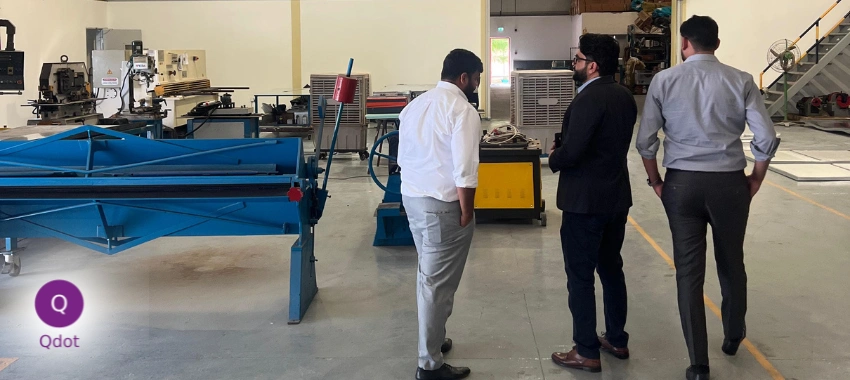
Qdot delivers ISO 45001 Consultancy in Saudi Arabia, guiding organizations through the design, documentation and rollout of a functioning Occupational Health and Safety Management System ahead of ISO 45001 Certification in Saudi Arabia. Instead of pulling files together in the final days before an audit, our consultants shape the system around hazards that genuinely exist on site, controls that actually reduce risk, and worker input that is real rather than a formality, so the OHSMS holds up during everyday operations and not only in front of an auditor.
Across construction, oil and gas, manufacturing, logistics, healthcare and facility management, Saudi businesses are being asked for ISO 45001 more frequently, whether to qualify for tenders, clear vendor registration portals, satisfy Aramco and NEOM supplier criteria, or simply meet their duty of care toward the people who work for them. Qdot gets your organization ready for that audit, then hands over to an independent, accredited certification body once readiness is genuine rather than assumed.
What Is ISO 45001?
ISO 45001 is the international standard covering Occupational Health and Safety Management Systems, issued by the International Organization for Standardization in March 2018. It took over from BS OHSAS 18001, the earlier benchmark for managing workplace safety, once a transition window that closed in 2021 came to an end. No separate “ISO 45001:2015” edition exists; 2018 remains the only version released to date.
At its core, the standard requires organizations to identify hazards, assess and bring occupational health and safety risk under control, draw workers into decisions that affect their own safety, and keep improving OH&S performance over time rather than treating it as a box-ticking exercise. It suits any organization irrespective of size, sector or the type of work carried out, whether that is a small trading office or a large multi-site industrial operation.
Because ISO 45001 shares the Annex SL high level structure and the Plan Do Check Act cycle used by ISO 9001 and ISO 14001, many Saudi organizations choose to pursue quality, environmental and occupational health and safety certification together as a single integrated management system rather than running three separate projects.
Why ISO 45001 Matters for Businesses in Saudi Arabia
Workplace safety duties in the Kingdom fall mainly under the Saudi Labor Law, which the Ministry of Human Resources and Social Development enforces, while occupational injury claims are handled through the General Organization for Social Insurance (GOSI). The National Council for Occupational Safety and Health steers the country's broader OSH direction as part of Vision 2030's National Transformation Program. None of this is replaced by ISO 45001, but a well-built OHSMS gives a business an organized way to keep on top of these obligations and to show that safety risk is being managed before something goes wrong, not just afterward.
Regulation aside, ISO 45001 now shows up regularly as a prequalification condition in Saudi tenders, in Aramco and NEOM vendor registration, and in client HSE questionnaires, typically alongside ISO 9001 and ISO 14001. Contractors in construction and EPC, oil and gas suppliers, manufacturers, logistics providers, facility management firms and healthcare organizations are among those most often required to hold the certificate before they can bid for work or register as an approved vendor. Our blog on which ISO standards Saudi contractors should combine for tender prequalification goes into this in more depth.
ISO 45001 Consultancy: What Qdot Actually Does
An ISO 45001 consultant and a certification body are not the same thing. Qdot sits on the preparation side of the process, covering gap analysis, documentation, training, implementation support, internal audit and certification audit readiness. The audit itself, and the call on whether to award the certificate, belongs entirely to an independent, accredited certification body.
We see the same three problems recur when Saudi businesses attempt an OHSMS without proper guidance. First, a hazard identification and risk assessment register lifted from a generic template rather than built around what actually happens on that specific site, with its own equipment and contractors. Second, worker consultation reduced to a signature on a form instead of genuine input into how risk decisions get made, even though this is one of the clearest ways ISO 45001 sets itself apart from older safety standards. Third, an emergency response plan that has sat untested against any realistic scenario. Qdot starts with how your operation actually runs, then maps that reality onto the standard's clauses, so nothing is left to chance once the audit arrives.
Core Requirements of ISO 45001
ISO 45001 rests on a set of interlinked clauses. Knowing what they cover helps a business understand what an ISO 45001 audit is really looking for, beyond simply which documents exist.
- Context and interested parties. Working out which internal and external issues, and which needs of workers, regulators and clients, have a bearing on the OHSMS.
- Leadership and worker participation. Top management taking ownership of OH&S outcomes, backed by documented ways of consulting and involving workers in hazard identification and decision making.
- OH&S policy and objectives. A written policy and measurable objectives aimed squarely at preventing injury and ill health, going beyond the legal minimum.
- Hazard identification and risk assessment. Spotting hazards in both routine and non-routine work, then bringing risk under control through the hierarchy of controls: elimination, substitution, engineering controls, administrative controls and personal protective equipment, in that order of preference.
- Legal and other requirements. A register covering applicable Saudi OSH legislation and any other obligations the organization has taken on, checked periodically for compliance.
- Operational planning and control. Putting controls in place for activities tied to significant risk, contractors and site visitors included.
- Emergency preparedness and response. Mapping out possible emergencies, from fire to chemical exposure to equipment breakdown, and building and rehearsing a response plan for each.
- Performance evaluation. Monitoring, measuring, running internal audits and holding management reviews to check the OHSMS is doing what it is meant to.
- Incident investigation and improvement. Looking into incidents and nonconformities, acting on corrective measures and steadily raising OH&S performance over time.
Our Step-by-Step ISO 45001 Implementation Approach
Qdot works through a defined sequence on ISO 45001 projects in Saudi Arabia, scaled to each business's size, site count and risk profile.
- An initial consultation to pin down business activity, scope, sites, headcount and the target certification date.
- Gap analysis measured against ISO 45001 requirements and how the site currently handles safety.
- Hazard identification and risk assessment (HIRA) spanning routine, non-routine and emergency conditions.
- A legal register mapping the Saudi Labor Law and OSH obligations that apply to the specific business activity.
- Building out documentation: the OH&S policy, procedures, registers and forms the system needs.
- Awareness sessions and internal auditor training for process owners, site staff and safety committees, run in English and Arabic where needed.
- Implementation support as operational controls go live and evidence is gathered across departments and sites.
- Internal audit and management review to close out gaps before the external audit arrives.
- Coordination through the certification audit itself, supporting Stage 1 and Stage 2 with an accredited certification body.
Key OHSMS Documents and Deliverables
A properly implemented ISO 45001 system leaves behind a specific set of records, not a stack of generic templates.
| Document / Register | What It Covers |
|---|---|
| OHSMS scope and OH&S policy | Sets the boundaries of the system and records top management's commitment |
| Hazard identification and risk assessment register | Catalogues workplace hazards, their assessed risk levels and the controls in place |
| Legal and other requirements register | Keeps track of applicable Saudi OSH laws, permits and other obligations |
| OH&S objectives and programs | Lays out measurable targets and the actions needed to reach them |
| Operational control procedures | Explains how significant risks, including those involving contractors, are controlled day to day |
| Emergency preparedness and response plan | Readies the organization to respond to fire, spills, medical emergencies and similar incidents |
| Incident reporting and investigation procedure | Documents how incidents, near misses and nonconformities are looked into and closed out |
| Internal audit program and records | Provides evidence the OHSMS has been tested internally ahead of the external audit |
| Management review minutes | Captures senior management's periodic look at OH&S performance and risk |
From Consultancy to Certification: What the ISO 45001 Audit Involves
Once the OHSMS is up and running and has been through an internal audit, the certification body steps in. Accredited certification bodies generally run the ISO 45001 audit across two stages. Stage 1 goes through the documentation and checks overall readiness, confirming the management system has been built to meet ISO 45001 and that the organization has a solid grasp of its significant hazards and legal obligations. Stage 2 tests whether the system is genuinely being followed on the ground, through site visits, conversations with workers and a review of evidence, including how hazards are actually being controlled at the point where work happens.
Accreditation is what makes a certificate worth something. It confirms the certification body itself has been assessed and approved by a recognized accreditation body and belongs to the International Accreditation Forum. Qdot only works alongside accredited certification bodies and never certifies its own consultancy clients, which is what keeps our advice independent. We help coordinate with the certification body and support the closure of any nonconformities raised during the audit, though the certification decision itself always stays with that independent body.
ISO 45001 and OHSAS 18001: What Changed
Organizations that once held OHSAS 18001 often ask what ISO 45001 actually changed. The biggest shifts are a sharper focus on the organization's context and the needs of interested parties, a clear requirement for leadership and worker participation rather than safety being delegated downward, a move toward a risk and opportunity based approach in place of a purely compliance driven one, and a shared high level structure that makes combining ISO 45001 with ISO 9001 and ISO 14001 considerably easier. OHSAS 18001 was formally retired once its transition period ran out, so any organization still holding that certificate needs to move across to ISO 45001 to keep an internationally recognized OH&S credential.
Benefits of ISO 45001 Certification for Saudi Businesses
A working OHSMS brings advantages that go beyond the certificate itself:
- Fewer workplace incidents, near misses and lost-time injuries thanks to structured hazard control
- Lower costs tied to accidents, insurance claims and occupational injury cases handled through GOSI
- Stronger standing for tenders, Aramco and NEOM vendor registration, and client HSE prequalification
- Better worker morale, retention and genuine involvement in safety decisions
- An organized way to track Saudi Labor Law and other OSH obligations
- Simpler integration with ISO 9001 and ISO 14001 for businesses building an integrated management system
Industries Across Saudi Arabia That Rely on ISO 45001
ISO 45001 is not confined to a single sector. Across Saudi Arabia, demand for it tends to come from:
- Construction and EPC contractors managing site safety and keeping subcontractors under control
- Oil, gas and petrochemical suppliers meeting Aramco and vendor registration HSE expectations
- Manufacturing and industrial plants dealing with equipment, chemical and process risk
- Logistics, warehousing and facility management companies standardizing safety practice across sites
- Healthcare providers managing clinical, biological and occupational exposure risk
- Food processing, hospitality and trading businesses putting formal workplace safety in place for the first time
Whether a business is applying for the first time or upgrading an informal safety program, the reason for working with Qdot tends to be the same: a tender, customer or governance requirement that has to be met properly rather than superficially.
What Affects ISO 45001 Consultancy Cost and Certification Timeline in Saudi Arabia
As a rough guide, a small to mid-sized organization pursuing ISO 45001 on its own can often reach audit-ready status within 45 to 60 days, provided staff are reasonably available. Higher-risk industries, multi-site operations and integrated management system projects usually take longer. Qdot puts together a cost and timeline proposal once we understand your scope, rather than handing out a generic number.
| Factor | Why It Matters |
|---|---|
| Number of sites and high-risk activities | More locations and more hazardous processes mean more risk assessments and controls to put in writing |
| Existing safety records and incident history | Businesses that already hold hazard registers, training records and incident data move through gap analysis faster |
| Nature of occupational risk | Higher-risk work, such as confined space entry, work at height or hot work, calls for more detailed controls |
| Headcount and contractor use | Larger workforces and heavier reliance on contractors widen the training and consultation scope |
| Integration with other standards | Pairing ISO 45001 with ISO 9001 or ISO 14001 can cut down on duplicate documentation and audit time |
After Certification: Surveillance Audits and Recertification
ISO 45001 certificates typically run on a three-year cycle: surveillance audits in years one and two confirm the OHSMS is still being kept up, followed by a full recertification audit in year three. As a business grows, its hazards, contractors and operations shift too, so the hazard register and legal register need attention between audits rather than only at renewal. Qdot stays with clients through this cycle, refreshing risk assessments, updating documentation and getting things ready ahead of each surveillance visit.
Where We Support ISO 45001 Clients in Saudi Arabia
Qdot supports ISO 45001 consultancy for organizations across Riyadh, Jeddah, Dammam, Al Khobar, Al Jubail, Yanbu, Mecca, Madinah and Tabuk, delivered through onsite visits, remote sessions or a hybrid model depending on where your sites are and what the project needs.
Why Businesses Choose Qdot for ISO 45001 Consultancy in Saudi Arabia
Qdot holds certification to ISO 9001:2015 and to ISO 20700:2017, the international standard covering management consultancy services. As far as we are aware, Qdot is the only ISO consultancy in the GCC certified to ISO 20700:2017, which means our own way of working is held to the same standard we expect clients to build into their OHSMS.
Since 2016, Qdot has worked with more than 4,000 clients and taken over 1,000 ISO certifications to completion across Saudi Arabia and the broader GCC, with roughly 95 percent of clients staying on with us long after certification, through their surveillance and recertification cycles. We only work with certification bodies accredited by recognized international accreditation bodies, and we carry no commercial relationship with any particular certification body, which is what keeps our advice independent.
Our full methodology is set out on the Qdot Methodology page, and you can review the organizations we have worked with on our major clients page.
Ready to Start Your ISO 45001 Project?
Tell us about your business activity, employee count, site locations, contractor exposure and target certification date, and we will put together a realistic route through gap analysis, documentation, implementation and audit readiness for ISO 45001 in Saudi Arabia. For a broader look at what we offer across other standards, visit ISO Consultancy in Saudi Arabia.
FAQs
ISO 45001 is the international standard for Occupational Health and Safety Management Systems. It lays out how organizations should identify hazards, assess and control OH&S risk, bring workers into safety decisions, and keep raising the bar on workplace safety performance over time.
Consultancy covers the groundwork: gap analysis, documentation, training, implementation and internal audit. Certification is what follows, granted by an independent, accredited certification body once a formal audit has been completed. Qdot handles the consultancy side; the certification body is the one that issues the certificate.
No. Qdot works as a consultancy. We get organizations ready for certification and liaise with an accredited certification body, but the audit itself and the decision that follows are handled entirely by that independent party.
ISO 45001 took over from OHSAS 18001 once its transition period wrapped up in 2021. It brings a sharper focus on organizational context, holds leadership directly accountable, gives worker participation more weight, shifts toward thinking in terms of risk and opportunity rather than compliance alone, and shares a common structure with ISO 9001 and ISO 14001 that makes integration far simpler.
No. ISO 45001 was published for the first time in March 2018 and that remains the only edition released. The mix-up with 2015 usually comes from confusing it with ISO 9001:2015 or ISO 14001:2015, which happen to carry that edition year.
Cost hinges on the number of sites involved, how much occupational risk is present, what safety documentation already exists, and whether ISO 45001 is being pursued alongside other standards. Qdot puts together a clear quotation once we understand the scope of your business.
A small to mid-sized organization going for ISO 45001 on its own can often reach audit-ready status in about 45 to 60 days. Higher-risk operations or those spread across multiple sites usually need more time.
Yes. Qdot runs awareness training and internal auditor training for ISO 45001, tailored to the industry involved and able to be combined with training for other standards where an integrated system is being developed.